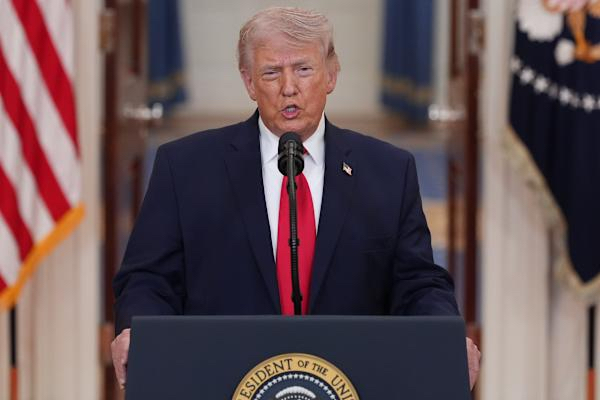
Donald Trump is moving to cancel about $810 million in federal spending that Congress already approved, invoking a rarely used “pocket rescission” just days before the end of the fiscal year and reigniting a broader fight over how much power the White House has to override congressional spending decisions.
The White House said Friday that Trump was using authority under the Impoundment Control Act to rescind funding it considers wasteful or harmful. The cuts span several federal agencies and include money for refugee and migrant services, education, housing, minority-owned businesses and other programs.
But the move immediately drew opposition from lawmakers, including Senate Appropriations Committee Chair Susan Collins, a Republican, who called any attempt to rescind congressionally approved funding without congressional approval “a clear violation of the law.”
The political news that affects your wallet, your rights and your vote, broken down in plain language. Free in your inbox.
“OMB is an agency of the executive branch. It does not get to decide which programs are worth funding,” Collins said.
A last-minute test of presidential power
Under federal law, the president can ask Congress to rescind previously approved funding. Congress then has 45 legislative days to consider the request.
The Trump administration is relying on a more aggressive interpretation of that authority, sending its rescission request with only days remaining in the fiscal year. The administration argues that funds withheld until the fiscal year expires can effectively be canceled without Congress voting on the request.
That timing leaves lawmakers little opportunity to intervene before the money expires. The Government Accountability Office has said the pocket-rescission approach is illegal, while the Trump administration argues that the maneuver is permitted under the Impoundment Control Act.
The fiscal year ends Sept. 30.
The White House used the same strategy last year to block about $4.9 billion in foreign aid that Congress had approved. The Supreme Court allowed those funds to remain withheld while litigation continued but did not issue a final ruling on the underlying legality of the rescission.
This time, the administration is targeting domestic programs, raising the stakes in the ongoing dispute over Congress’ constitutional power to control federal spending.
Republicans join Democrats in pushing back
Collins said Friday that the administration had withheld the money for months in order to reach the end of the fiscal year and execute what she described as an unlawful cancellation of appropriations.
“This move shows that OMB intentionally withheld these funds for months to execute this unlawful cancellation of appropriations that were approved on a bipartisan basis and signed into law,” Collins said.
Democrats also accused the White House of attempting to circumvent Congress.
House Appropriations Committee ranking Democrat Rosa DeLauro called on Republicans to join Democrats in rejecting the move, while Sen. Patty Murray, the Senate panel’s top Democrat, said the administration was effectively treating congressional votes as optional.
The objections underscore the unusual nature of the dispute: The fight is not simply over which programs should receive federal money, but over who has the final authority to decide whether money that Congress has appropriated will actually be spent.
What Trump is cutting
The largest portion of the rescission — about $567 million — involves Health and Human Services programs serving refugees, asylum seekers and other migrants.
The White House argues those funds are no longer necessary because illegal border crossings have fallen sharply. The administration has also targeted funding for education programs serving migrant students, housing programs, minority-business initiatives and other grants it characterizes as ideological or inconsistent with Trump’s agenda.
The administration describes the package as an effort to eliminate wasteful government spending.
Critics, however, say Trump is using the end of the fiscal year to accomplish something Congress has not agreed to do: cancel spending that lawmakers already approved.
A broader battle over the power of the purse
The latest rescission is part of a larger struggle between the Trump administration and Congress over the limits of executive power.
The Constitution gives Congress control over federal appropriations, while presidents are responsible for carrying out the laws Congress passes. The dispute over pocket rescissions tests where those powers intersect when a president refuses to spend money lawmakers have directed the government to spend.
The Supreme Court’s handling of last year’s foreign-aid rescission did not definitively resolve that question. The court’s decision allowed the administration’s withholding of the funds to continue while litigation proceeded, leaving the underlying legal dispute unresolved.
The latest move could therefore set up another legal battle over the boundaries of presidential spending authority.
And because the administration is now applying the strategy to domestic programs, the fight could have consequences far beyond foreign aid.
For Trump, the rescission is another opportunity to use executive power to reshape federal spending without waiting for Congress to approve his preferred priorities.
For lawmakers, the question is whether Congress’ power of the purse means what it says, or whether a president can effectively nullify spending decisions by waiting until the final days of the fiscal year to act.